next up previous
Next: About this document ... Up: 4/02/2003 by Randhir Kumar Previous: 4/02/2003 by Randhir Kumar

Lyapunov Stability

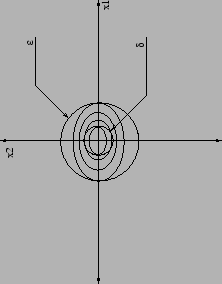
Definition 5.1.1   Stability The equilibrium is stable if for each $ \varepsilon >0$ and each $ t_{0} \epsilon \mathbb{R}_{+}$ there exists a

$\displaystyle \delta = \delta (\varepsilon ,t_{0})$ (5.1)

such that

$\displaystyle \vert\vert X_{0}\vert\vert < \delta (\varepsilon ,t_{0}) \Rightarrow \vert\vert S(t,t_{0},X_{0})\vert\vert<\varepsilon \forall t>t_{0}$ (5.2)

where
$ X_{0}$ is the initial Condition. $ S(t,t_{0},X_{0})$ is the solution trajectory (Starting from initial condition and initial time $ t_{0}$)

It is uniformly stable if for each $ \varepsilon >0$ there exists $ \delta =\delta (\varepsilon )$ such that $ \vert\vert X_{0}\vert\vert<\delta (\varepsilon )\Rightarrow \vert\vert S(t,t_{0},X_{0})\vert\vert\leq \varepsilon \forall t\geq t_{0}$.

Example 5.1.1  

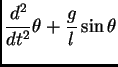
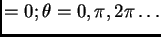
$\displaystyle \frac{d^{2}}{dt^{2}}\theta + \frac{g}{l}\sin \theta$ $\displaystyle =0 ; \theta =0,\pi ,2\pi \ldots$ (5.3)
$\displaystyle x_{1}$ $\displaystyle = \theta$ (5.4)
$\displaystyle \frac{dx_{1}}{dt}$ $\displaystyle = x_{2}$ (5.5)
$\displaystyle \frac{dx_{2}}{dt}$ $\displaystyle = -\frac{g}{l}\sin \theta$ (5.6)

Figure 5.1: Stable Equilibrium
\begin{figure}
\begin{center}
\psfig{figure=fig1.ps,width=.4\linewidth}
\end{center}
\end{figure}

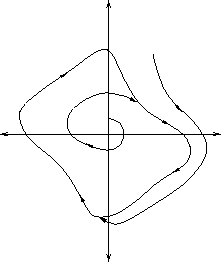
Example 5.1.2  

$\displaystyle \frac{dx_{1}}{dt}$ $\displaystyle = x_{2}$ (5.7)
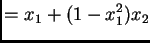
$\displaystyle \frac{dx_{2}}{dt}$ $\displaystyle =x_{1}+(1-x_{1}^{2})x_{2}$ (5.8)

Figure 5.2: Unstable Equilibrium
\begin{figure}
\begin{center}
\psfig{figure=fig2.ps,width=.4\linewidth}
\end{center}
\end{figure}

no $ \delta $ can be found for this $ \varepsilon $. If we take $ \varepsilon $ sufficiently large to contain the limit cycle then we can find a $ \delta $ which satisfies the stablity criterion but is should be true for each and every $ \delta $.

Definition 5.1.2   The equilbrium $ \overline{0}$ is attractive if for each $ t_{0} \in \mathbb{R}_{+}$ there is $ \eta (t_{0})>0$ such that

$\displaystyle \vert\vert X_{0}\vert\vert<\eta (t_{0})\Rightarrow S(t,t_{0},X_{0})\rightarrow 0$    as $\displaystyle t \rightarrow \infty$ (5.9)

Definition 5.1.3   It is uniformly attractive if there is $ \eta >0$ such that

$\displaystyle \vert\vert X_{0}\vert\vert<\eta \Rightarrow S(t,t_{0},X_{0})\rightarrow 0$ (5.10)

as $ t\rightarrow \infty$ uniformly in $ t_{0},X_{0}$

Attractivity doesn't imply stability and vice versa. Another Definiton of stability: Asymptotic Stability

Definition 5.1.4   Equilibrium $ \overline{0}$ is uniformly asymptotically stable if it stable and attractive.

Definition 5.1.5   Equilibrium $ \overline{0}$ is uniformly asymptotically stable if it is uniformly stable and uniformly attractive.

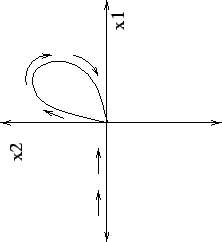
Example 5.1.3   Vinograd's Equation (1957)

$\displaystyle \frac{dx_{1}}{dt}$ $\displaystyle = \frac{x_{1}^{2}(x_{2}-x_{1})+x_{2}^{5}}{x_{1}^{2}+x_{2}^{2}[1+(x_{1}^{2}+x_{2}^{2})^{2}]}$ (5.11)
$\displaystyle \frac{dx_{2}}{dt}$ $\displaystyle =\frac{x_{2}^{2}(x_{2}-2x_{1})}{(x_{1}^{2}+x_{2}^{2})[1+(x_{1}^{2}+x_{2}^{2})^{2}]}$ (5.12)

equilibrium $ \equiv (0,0)$

Figure 5.3: Not Stable but attractive
\begin{figure}
\begin{center}
\psfig{figure=fig3.ps,width=.4\linewidth}
\end{center}
\end{figure}

Definition 5.1.6   Exponentional Stability
Equilibrium $ \overline{0}$ is exponentionally stable if there exists constants $ r,a,b>0 $ such that

$\displaystyle \vert\vert S(t,t_{0,}X_{0})\vert\vert\leq a\vert\vert X_{0}\vert\vert e^{[-b(t-t_{0})]}$ (5.13)

for all $ t>t_{0}$ and $ x_{0}\epsilon B$

All the linear systems if they are stable, they an exponentially stable.

Definition 5.1.7   Global Uniform Asymptotic Stability
Equilibrium $ \overline{0}$ is globally uniformly asymptotially stable if

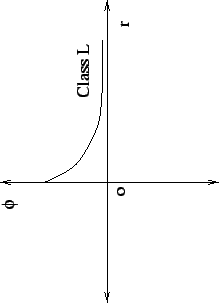
Definition 5.1.8   it Function of Class K and Class L
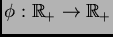
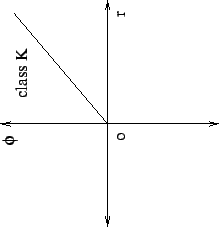
Function $ \phi : \mathbb{R}_{+}\rightarrow \mathbb{R}_{+}$ is of class K if it is continuous, strictly increasing, and $ \phi(0) = 0$. It is class L if it is continuous on $ [0,\infty)$ strictly decreasing, $ \phi (0)<\infty$, $ \phi(r) \rightarrow 0$ as $ r\rightarrow \infty \protect$

Figure 5.4: Class K
\begin{figure}
\begin{center}
\psfig{figure=fig4.ps,width=.4\linewidth}
\end{center}
\end{figure}

Figure 5.5: Class L
\begin{figure}
\begin{center}
\psfig{figure=fig5.ps,width=.4\linewidth}
\end{center}
\end{figure}

Definition 5.1.9   Definition:Locally Positive Definite Function and Positive Definite Function
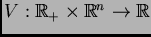
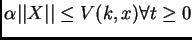
A function $ V : \mathbb{R}_{+} \times \mathbb{R}^{n}\rightarrow \mathbb{R}$ is said to be locally positive definite function/positive definite function:(lpdf)/(pdf)
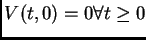
V is decrescent if there exists a constant $ r>0$ and a function $ \beta$ of class K such that $ V(t,x)\leq \beta (\vert\vert X\vert\vert) \forall t>0$ and $ X\epsilon B_{r}$ V is radially unbounded if * is satisfied for some $ \alpha _{1}$ (not necessarily class K) with additional property $ \alpha _{1}(r)\rightarrow \infty$ as $ r\rightarrow \infty \protect$

Figure 5.6: Radially Unbounded
\begin{figure}
\begin{center}
\psfig{figure=fig5.ps,width=.4\linewidth}
\end{center}
\end{figure}


next up previous
Next: About this document ... Up: 4/02/2003 by Randhir Kumar Previous: 4/02/2003 by Randhir Kumar
Vishal Mahulkar (98D10043) 2003-02-14