next up previous
Next: Dynamic friction (Lugre) Model Up: Uniqueness and existence of Previous: Uniqueness and existence of

Conditions for uniqueness and Global/Local existence of solution

Suppose the function f satisfies the following conditions $ \exists$ finite constants $ T,r,h$ and $ K,S,T$ Lipschitz Condition for local existence.
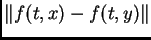
$\displaystyle \Vert f(t,x)-f(t,y)\Vert$ $\displaystyle \leq k \Vert X-Y\Vert \quad \forall [X,Y] \in B_{r} \quad \forall \,t \in [0,T]$ (4.1)
$\displaystyle \Vert f(t,x_{0}\Vert$ $\displaystyle \leq h \quad \forall t \in [0,T]$ (4.2)


where $ B_{r}= [ X \in \mathbb{R}^{n}: \Vert X-X_{0}\Vert \leq r ]$ then it has exactly one solution over $ [0,\infty]$ whenever $ \delta $ is sufficiently small to satisfy

$\displaystyle h \delta e^{k\delta}$ $\displaystyle < r$ (4.3)
$\displaystyle \delta$ $\displaystyle < \min [T, \frac{\rho}{k}, \frac{r}{(k r +h)}]$ (4.4)

Lipschitz Condition for Global existence.

$\displaystyle \Vert f(t,x)-f(t,y)\Vert \leq k\Vert X-Y\Vert \quad \forall [X,Y] \in \mathbb{R}^{n},\;\forall \; t \in [0,\infty]$ (4.5)

Corollary 4.1.1   Consider,if $ f(t,x)$ is conditionally differentiable then $ f$ is Lipschitz.
$\displaystyle f_{1}$ $\displaystyle =$ $\displaystyle \dot x_{1}$ (4.6)
$\displaystyle \dot x_{1}$ $\displaystyle =$ $\displaystyle x_{2}$ (4.7)
$\displaystyle f_{2}$ $\displaystyle =$ $\displaystyle \dot x_{2}$ (4.8)
$\displaystyle \dot x_{2}$ $\displaystyle =$ $\displaystyle u\mp F_{c}$ (4.9)
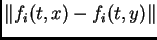
$\displaystyle \Vert f_{i}(t,x) - f_{i}(t,y)\Vert$ $\displaystyle \leq$ $\displaystyle k_{i}\Vert X-Y\Vert$ (4.10)

then prove that

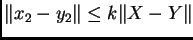
$\displaystyle \Vert x_{2}-y_{2}\Vert \leq k\Vert X-Y\Vert$ (4.11)

where $ X = \begin{bmatrix}x_{1} \\  x_{2} \\  \end{bmatrix}$ and $ Y = \begin{bmatrix}y_{1} \\  y_{2} \end{bmatrix}$
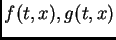
if $ f(t,x), g(t,x)$ are Lipschitz then

  $\displaystyle \Vert f_{1}(t,x) - f_{1}(t,y)\Vert \leq k_{1}\Vert X-Y\Vert$    
  $\displaystyle \Vert g_{1}(t,x) - g_{1}(t,y)\Vert \leq k_{2}\Vert X-Y\Vert$    
  $\displaystyle \Vert f_{1}(t,x) \times g_{1}(t,y) - f_{1}(t,y) \times g_{1}(t,y)\Vert \leq k_{3}\Vert X-Y\Vert$    
  $\displaystyle F_{1} = \Vert f_{1}(t,x)\times g_{1}(t,y) - f_{1}(t,y)\times g_{1}(t,y)\Vert$    
  $\displaystyle F_{1} = \Vert f_{1}(t,x)\times g_{1}(t,y)-f_{1}(t,y)\times g_{1}(t,x)$    
  $\displaystyle \quad + f_{1}(t,y)\times g_{1}(t,x) - f_{1}(t,y)\times g_{1}(t,y)\Vert$    
  $\displaystyle F_{1} \leq \Vert f_{1}(t,x)- f_{1}(t,y)\Vert\times \Vert g_{1}(t,x)\Vert$    
  $\displaystyle \quad + \Vert f_{1}(t,y)\Vert\times \Vert g_{1}(t,x) - g_{1}(t,y)\Vert$    
  $\displaystyle F_{1} \leq k_{1}\Vert X-Y\Vert g_{1}(t,x) + k_{2} \Vert X-Y\Vert\Vert f_{1}(t,y)\Vert$    
  $\displaystyle F_{1} = {k_{1}\Vert g_{1}(t,x)\Vert + k_{2} \Vert f_{1}(t,y)}\Vert\Vert X-Y\Vert$    


next up previous
Next: Dynamic friction (Lugre) Model Up: Uniqueness and existence of Previous: Uniqueness and existence of
Vishal Mahulkar (98D10043) 2003-02-14